
By Raman Rishi Dwivedi | Delhi Chronicles
Some monuments become so familiar in photographs that we stop looking closely at them.
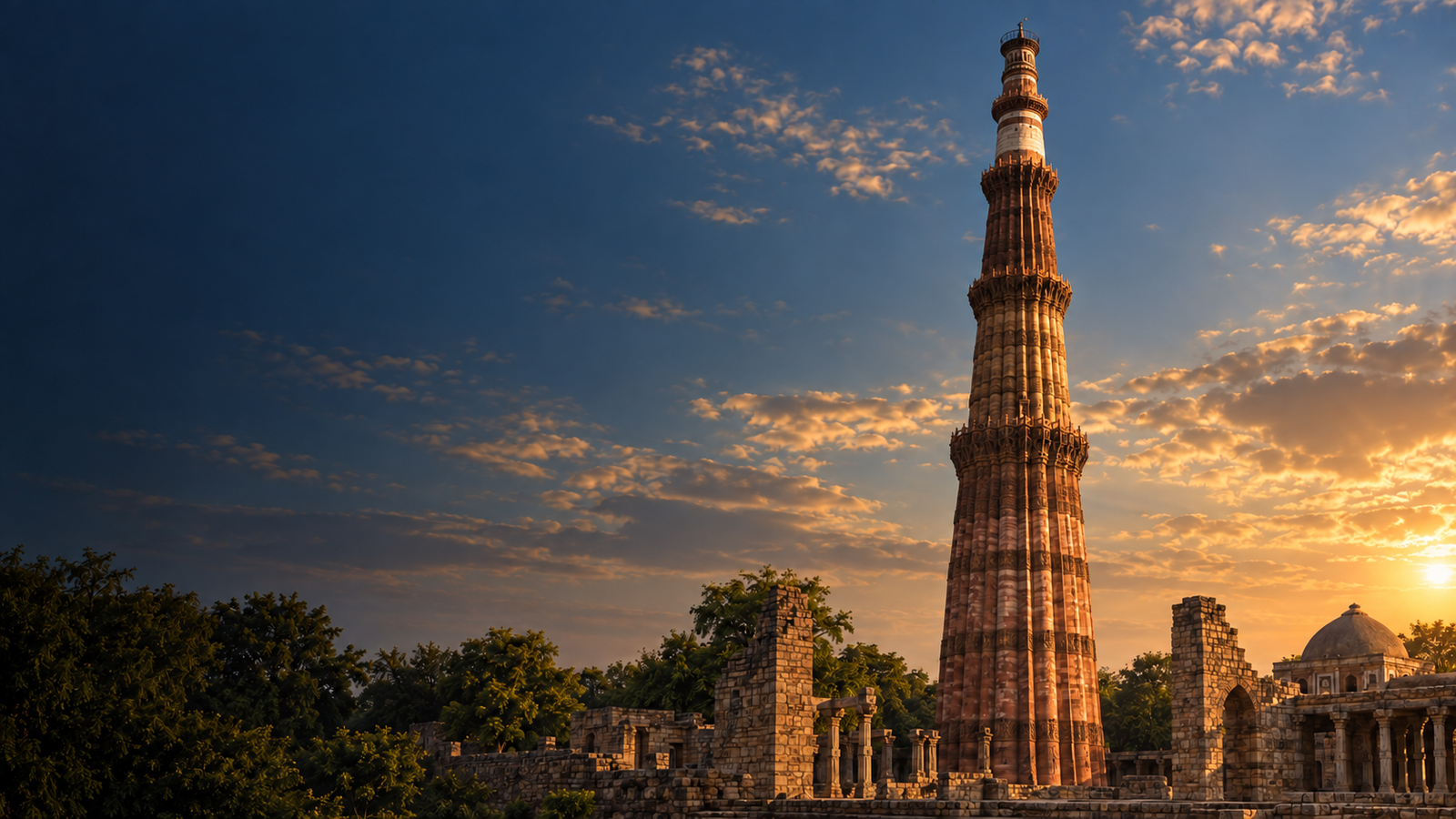
Qutab Minar—also commonly written as Qutub Minar—is one of those places. Its silhouette is instantly recognisable: a tapering tower rising above the ruins of Mehrauli, its stone surface marked by balconies, inscriptions and deeply carved lines.
Yet the familiar view is only a beginning. Look beyond the outline, and the monument opens into a much larger story: of rulers and craftspeople, religious architecture, changing ambitions, and the survival of buildings across centuries.
This is the setting for Qutab Minar, Delhi | A Walk Through History & Time, part of the Delhi Chronicles documentary series on Raman Cinema.
A monument shaped by successive rulers
Qutab Minar did not emerge fully formed under a single ruler. Delhi Tourism dates the laying of its foundation to 1199, when Qutb-ud-din Aibak began construction and raised the first storey. His successor, Iltutmish, added three more. Later repairs under Firuz Shah Tughlaq and Sikandar Lodi became part of the tower’s continuing history. Delhi Tourism
That sequence matters. It invites us to see the structure as something that developed over time, carrying the decisions of several generations.
A monument’s history includes the people who repaired it as well as those who first imagined it. What survives today is the result of both ambition and care.
Looking closely at the stone
Standing 72.5 metres high, the minaret combines an imposing scale with remarkably detailed surfaces. Its fluted stonework, inscriptional bands and projecting balconies give the eye a series of smaller forms to follow on its journey upward. UNESCO recognises the complex as an outstanding example of the architecture and artistic achievements of early Islamic India. UNESCO World Heritage Centre
For a filmmaker, this offers two different ways of seeing.
A wide composition can establish the height of the tower and its relationship with the surrounding space. A closer view can bring attention to the carving, the edges of a balcony, or the way light falls across the stone.
Both deserve time. The distant view gives us recognition; the detail gives us something to discover.
The history around the tower
The surrounding complex is essential to understanding Qutab Minar. The Quwwat-ul-Islam mosque incorporates carved architectural elements from earlier Hindu and Jain temples. These surviving materials are part of a history that includes conquest, religious change and the reuse of earlier structures. Their presence calls for attentive observation and careful historical context. UNESCO World Heritage Centre
Elsewhere, the tomb of Iltutmish, built in 1235, draws attention to intricate interior carving. The Alai Darwaza, constructed under Alauddin Khalji in 1311, adds another chapter to the site’s architectural development. Delhi Tourism
Moving between these buildings changes the experience of the place. The tower remains a point of reference, while the surrounding spaces reveal how much history sits outside its familiar silhouette.
The ambition of an unfinished tower
One of the complex’s most thought-provoking structures is the unfinished Alai Minar.
Alauddin Khalji intended it to be twice the scale of Qutab Minar, but only its first storey was completed. Delhi Tourism
Its unfinished form leaves room for a different kind of reflection. We can see the beginning of an enormous undertaking, while its intended completion remains something to imagine.
Beside the completed Qutab Minar, it gives ambition a visible contrast: one tower that became an enduring landmark, and another whose story is held in what remains incomplete.
A slower way to see Delhi
Places like Qutab Minar reward patience.
It is easy to arrive with a photograph already in mind, find the familiar angle and move on. Staying longer allows other details to enter the frame: the relationship between a column and an arch, the repetition of carved forms, the changing appearance of a surface as the light shifts.
That slower attention is central to the approach of Delhi Chronicles. The city offers more than a sequence of landmarks. Its buildings and spaces invite us to consider how the past remains present in everyday surroundings.
Cinema offers a way to spend time with those details—to let a place unfold through images, sound and movement.
Watch the full documentary
Continue the journey with Qutab Minar, Delhi | A Walk Through History & Time | Delhi Chronicles, now available on Raman Cinema on YouTube.
The film is an invitation to pause, look closer, and spend time with one of Delhi’s most recognisable monuments.
A film by Raman Rishi Dwivedi
Rohini Films