
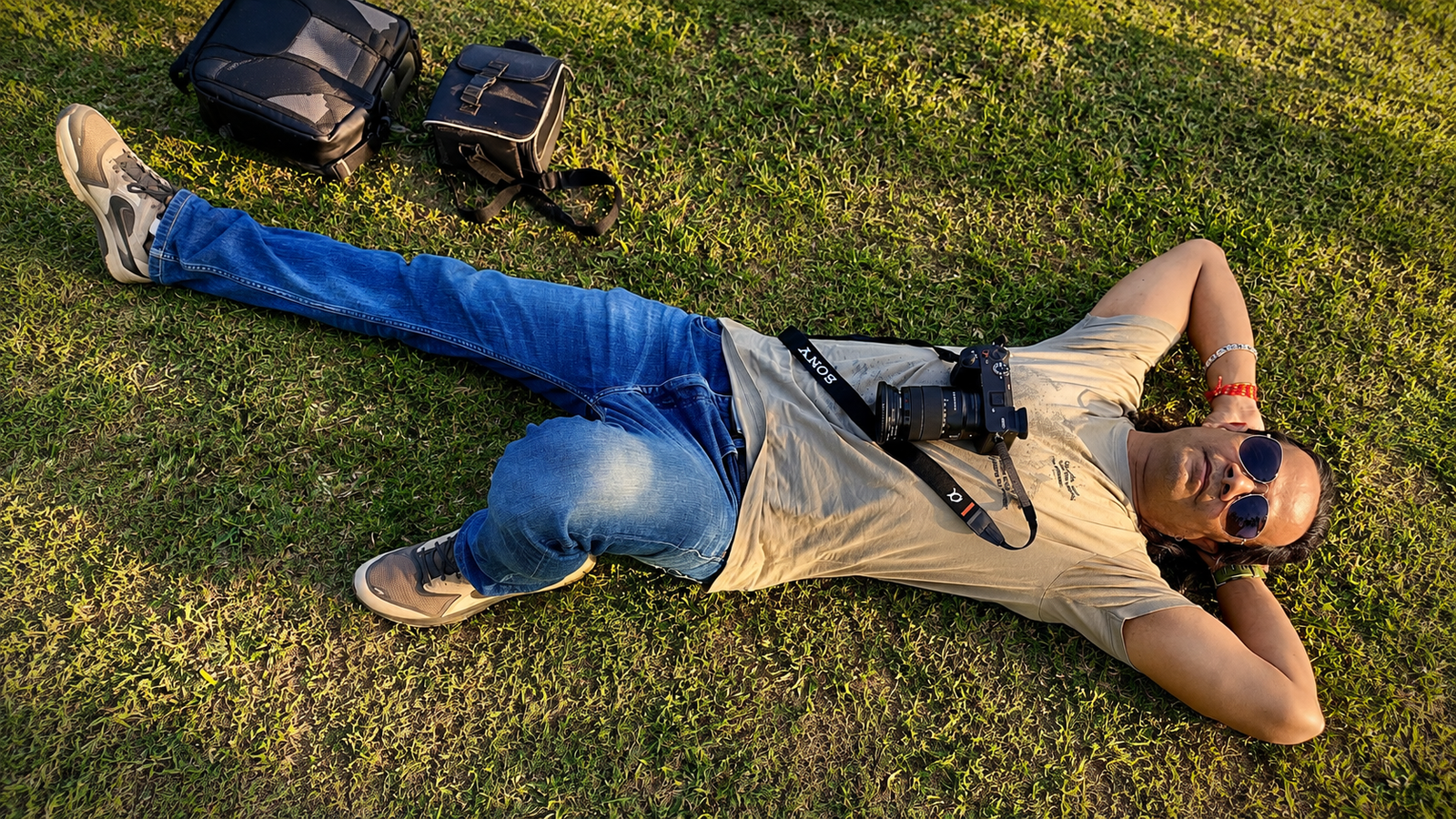
I have just returned home after several days of travelling and filming.
The cameras are back in their cases. Batteries are being charged. Memory cards have been copied, footage is finding its way onto hard drives, and soon I will sit in front of the editing timeline and begin going through everything we have brought back.
Technically, the shoot is over.
But somehow, it never feels that way.
Because when you return from a documentary shoot, what comes home with you is much more than what was recorded by the camera.
The Things That Never Reached the Memory Card
Every shoot leaves you with footage.
There are landscapes, faces, conversations, sounds, unexpected moments and carefully composed shots. These are the things that eventually become visible to an audience.
But there is another part of the journey that remains invisible.
A conversation after the camera was switched off.
Someone you met who told you something you weren’t expecting to hear.
Tea shared before a shoot began.
The silence after an interview.
A place that affected you differently from how you had imagined it.
Sometimes even something you wanted to film but couldn’t.
None of these things necessarily exists on the memory card.
Yet somehow, they return home with you.
And eventually, they find their way into the film.
The Film You Planned and the Film You Found
Before travelling, I usually have some idea of what I am going to make.
For the documentary series I have been shooting recently, there may be research, a loose script and a broad understanding of the place. It gives me a direction.
But I don’t want that script to become a cage.
I arrive.
I look.
I listen.
And then reality begins changing the film.
Perhaps the light isn’t what I expected.
Perhaps a location that seemed important during research gives me very little when I actually reach it.
And then something I hadn’t planned at all suddenly becomes interesting.
Someone walks into the frame.
An ordinary activity begins somewhere nearby.
A sound makes me turn around.
A conversation takes the story somewhere else.
The camera follows.
By the time I return home, the film I have actually shot is rarely identical to the film I imagined before leaving.
I think that’s one of the reasons I continue enjoying documentary filmmaking.
There is still room to be surprised.
Some Films Are Different
Not every documentary begins this way.
Sometimes you travel with a story that already exists.
There are people you know you need to speak with. There are memories, histories and relationships that existed long before the camera arrived.
Even then, something changes when the actual filming begins.
People remember things differently.
One conversation leads to another.
A location brings back a memory nobody had planned to discuss.
Something said casually over tea can suddenly explain what hours of formal conversation could not.
You begin with a story.
But the people inside that story begin giving it another dimension.
In those situations, my responsibility as a filmmaker isn’t simply to collect the scenes I had planned.
It is also to recognise when the film is trying to tell me something I hadn’t anticipated.
Coming Home Changes the Way You See the Footage
During a shoot, everything happens quickly.
You are thinking about the frame, focus, exposure, sound, batteries, cards, movement, people and the next location.
You don’t always have the distance required to understand what you’ve captured.
That distance comes later.
For me, it begins when I return home.
I sit down with the footage without the urgency of the shoot around me.
And suddenly I begin noticing things.
A glance during an interview.
Someone waiting silently at the edge of a frame.
A shot I almost didn’t take.
A few seconds of natural sound.
An expression that means more now because I know what happened afterwards.
The camera recorded those moments.
But perhaps I didn’t fully see them when I filmed them.
That happens in the edit.
Editing Is Another Form of Writing
I’ve always believed that a film gets written more than once.
There is the film you imagine.
There is the film you shoot.
And then there is the film you discover on the editing timeline.
For documentary filmmaking, that final stage can completely change everything that came before it.
Two shots recorded on different days suddenly belong together.
An interview you thought would be central becomes shorter.
A small moment becomes important.
Music disappears from a sequence because silence works better.
A voice-over that seemed necessary becomes unnecessary because the images are already saying enough.
This is where editing stops being merely the process of joining shots together.
It becomes writing.
Only now, the words are images, voices, sounds, pauses and time.
The Difficult Part Is Knowing What to Leave Out
Returning with a great deal of footage creates another problem.
You become attached to things.
A shot may have taken considerable effort to capture. A location may have required hours of travelling. An interview may contain something personally meaningful.
But none of those things automatically earns a place in the finished film.
The film doesn’t know how difficult a shot was to obtain.
The audience doesn’t know either.
It either belongs in the story or it doesn’t.
After all these years, I still think one of the hardest parts of editing is removing something you like because the film doesn’t need it.
Sometimes the strongest decision a filmmaker makes is not what to show.
It is what to leave unseen.
And Then There Are the Memories
This recent journey has given me many hours of footage to work through.
There are several films waiting inside those hard drives now.
Over the coming weeks, I will begin finding them.
Some will become part of the documentary series I have been creating. They began simply — arrive at a place, observe what is happening, shoot what presents itself and discover the final rhythm later.
Another film belongs to a very different journey and will need its own time.
I don’t want to rush any of them.
Because sitting here now, having returned home, I realise that I’m not approaching the footage with exactly the same mind with which I left.
The journey has changed my understanding of what I filmed.
Perhaps that is part of documentary filmmaking too.
We travel somewhere believing that we’re going to bring a story home.
Sometimes we do.
But sometimes the journey brings something home inside the filmmaker as well.
And although the camera never recorded it, somehow it will be there in the finished film.
— Raman Rishi Dwivedi
Filmmaker | Rohini Films