
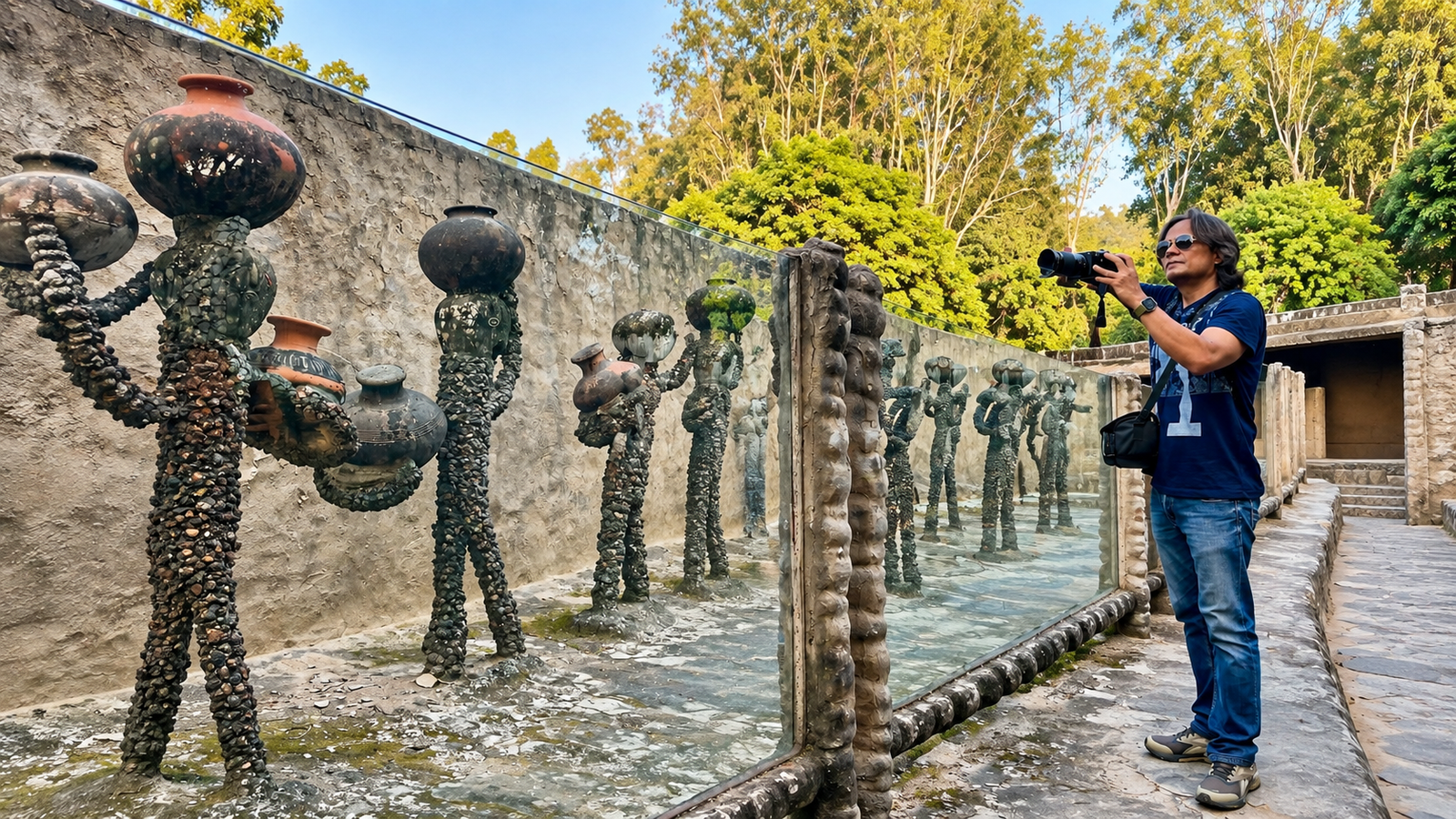
After more than three decades of filmmaking, I find myself increasingly interested in something very simple.
To arrive at a place.
To look around.
To listen.
And to allow the story to reveal itself.
I have spent much of my life behind a camera in one form or another. Over the years, I have worked on documentaries, music videos, television, advertisements, short films and feature films. Each form has taught me something different about storytelling.
But lately, I have found myself returning to documentary filmmaking with a different perspective.
I am less interested in controlling every moment.
I am more interested in observing it.
Returning to Where I Began
Documentary filmmaking isn’t new to me.
Some of my early professional work involved documenting the folk traditions and disappearing folk arts of Punjab for the Centre for Cultural Resources and Training. Those films required travelling, meeting people, listening to them and recording traditions as they existed.
Years later, after working across many other forms of filmmaking, I seem to have returned to something remarkably similar.
The equipment has changed.
The technology has changed enormously.
Perhaps I have changed too.
But the fascination remains the same — real people, real places and the stories hidden inside ordinary life.
Not Everything Needs to Become a Vlog
There is a tremendous amount of travel content being created today.
Much of it is energetic, informative and entertaining. A presenter takes us somewhere, tells us what to see, where to eat, what something costs and what we should experience.
There is absolutely a place for that.
But I realised that it isn’t how I naturally see a place.
When I arrive somewhere with my camera, I often want to remain quiet for a while.
I notice somebody walking through a frame.
I notice the sound of traffic disappearing as we move away from a city.
I notice an old building against the sky, a shopkeeper waiting for a customer, water moving through a landscape, people sitting together, or simply the way afternoon light falls across a street.
These moments may not appear important individually.
Together, however, they begin to describe a place.
That is where my current approach to observational documentary filmmaking comes from.
Letting the Camera Observe
When we filmed Ghamroj and the landscape beyond Gurgaon, the film wasn’t really about reaching a tourist destination.
The journey itself became part of the experience.
The roads changed. Buildings gradually disappeared. The landscape opened up. Expectations changed as we travelled.
Similarly, while filming Dwarka after the rain, there wasn’t a dramatic event waiting for us.
The streets themselves became the subject.
Rain had changed the familiar city for a few hours, and the camera simply had to notice it.
At Qutub Minar, the challenge was different. It is one of Delhi’s most photographed monuments. The question wasn’t whether I could show Qutub Minar.
Millions of photographs and videos already do that.
The question was:
Can I make somebody look at a familiar place again?
That question interests me much more.
Sometimes the Story Comes After the Shoot
I don’t always want to arrive with every sentence already written.
Of course, research matters. Preparation matters. Understanding where you’re going matters.
But documentary filmmaking also requires the freedom to discover something you hadn’t planned.
Sometimes I shoot first and understand the film properly only when I sit down to edit it.
A particular face stays with me.
A sound suddenly becomes important.
Two shots filmed hours apart begin speaking to each other.
A sequence that seemed essential while shooting becomes unnecessary.
And something captured almost accidentally becomes the heart of the film.
That is one of the pleasures of editing your own documentaries.
The film gets written once before the shoot, again through the camera, and once more on the editing timeline.
Learning to Let a Shot Breathe
We live in an age where we are constantly told that everything must become faster.
Cut sooner.
Grab attention.
Don’t allow the viewer to leave.
Those considerations are real, particularly when films are being watched online.
But cinema also needs space.
Sometimes a shot deserves another two seconds.
Sometimes natural sound communicates more than music.
Sometimes the audience doesn’t need to be told what to feel.
I am increasingly comfortable allowing those moments to remain.
It doesn’t mean making a film deliberately slow. It means allowing the rhythm of the subject to determine the rhythm of the film.
A crowded Delhi street should not necessarily feel like a quiet Himalayan village.
And a quiet Himalayan village should not be edited as though it were a crowded Delhi street.
The Camera Has Become Smaller. The Possibilities Have Become Larger.
One of the wonderful changes during my career has been the democratisation of filmmaking technology.
Today I can walk into a location with a relatively small camera, a lens, a microphone and a gimbal and create images that would once have required a much larger crew and considerably more equipment.
That changes more than convenience.
It changes behaviour.
People often become less conscious of a small camera. Locations remain more natural. I can move quickly when something unexpected happens.
For observational work, that freedom is enormously valuable.
But technology is still only the tool.
A better camera cannot decide where to look.
That remains the filmmaker’s responsibility.
Finding Extraordinary Stories in Ordinary Places
Perhaps this is what excites me most about this phase of my filmmaking.
I don’t necessarily have to travel halfway around the world looking for a story.
There are stories a few kilometres from home.
There are stories in Delhi’s markets, monuments, neighbourhoods and forgotten corners.
There are stories in the hills.
There are stories in villages.
There are stories in people carrying on with an ordinary day.
The challenge is learning to notice them.
And strangely, after spending more than thirty years making films, I feel that I am still learning how to look.
Perhaps that is why I enjoy taking the camera out again.
Not because I already know what the film will be.
But because I don’t.
And somewhere between arriving at a place and returning home with the footage, a story begins to emerge.
That uncertainty is not something I want to eliminate.
It is becoming one of the reasons I continue making films.
— Raman Rishi Dwivedi
Filmmaker | Rohini Films