
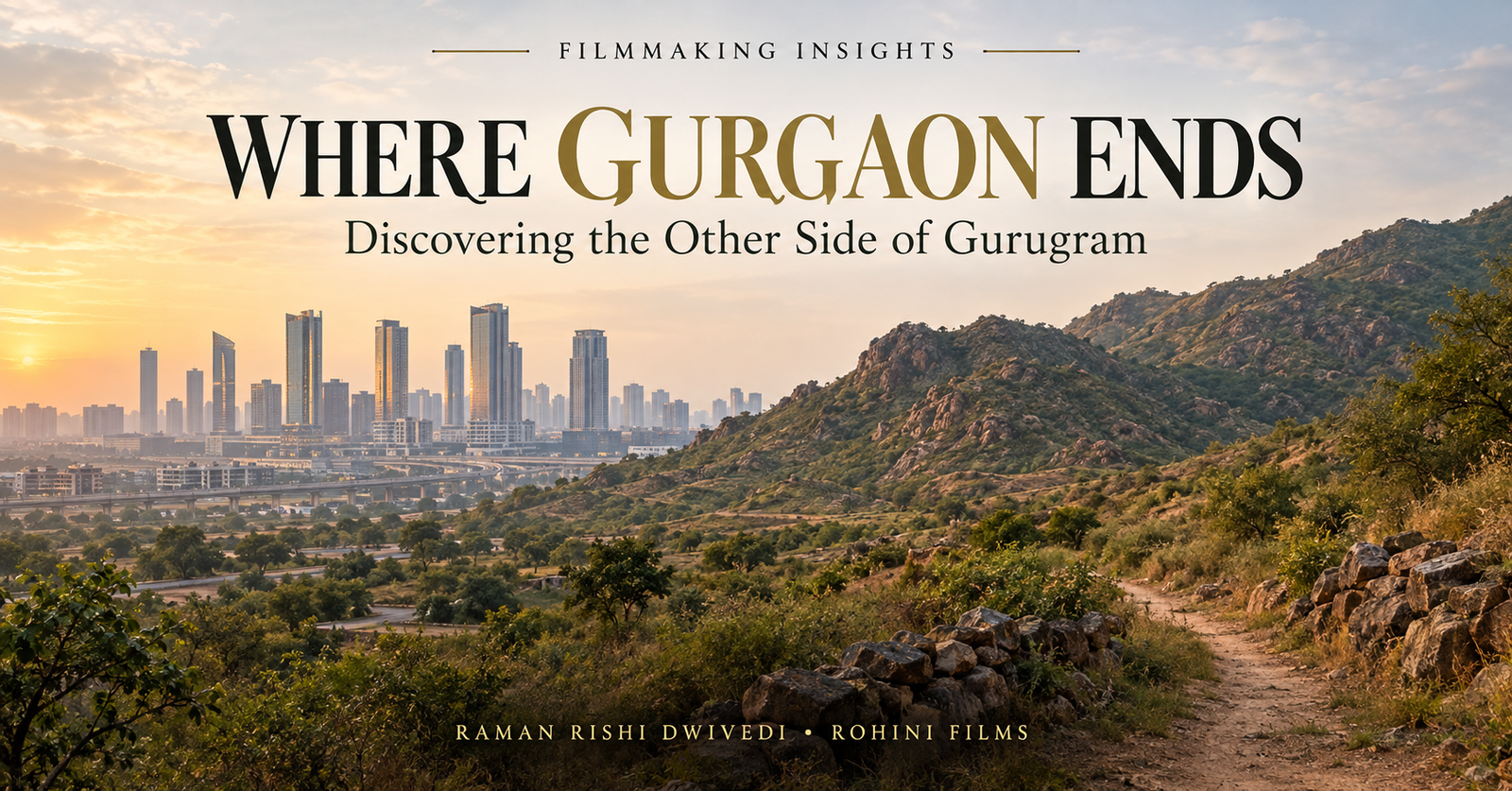
Beyond the glass towers, crowded highways and constant movement of Gurugram lies a landscape that feels like another world.
When we began our journey towards Ghamroj, we were looking for a waterfall. What we eventually found was something quieter and perhaps more meaningful—the lesser-seen side of Gurgaon.
Beyond the Gurgaon We Know
For most people, Gurgaon represents corporate offices, high-rise buildings, shopping centres and roads filled with traffic. It is a city associated with rapid development and ambition.
But as we travelled away from its familiar skyline, the roads gradually became narrower. Concrete began giving way to open land, village pathways and the rugged landscape of the Aravalli hills.
The transformation did not happen suddenly. It unfolded slowly through the windscreen—one turn, one road and one changing landscape at a time.
This gradual transition became the beginning of Where Gurgaon Ends.
The Journey Towards Ghamroj
Our destination was a waterfall near Ghamroj. The road took us past a temple, muddy tracks, patches of vegetation and small signs of village life.
There was no hurry in the journey. I wanted the camera to observe these changing surroundings naturally—the movement of vehicles, the texture of the roads, the silence around the hills and the small details that often disappear when we travel only to reach a destination.
The anticipation of finding the waterfall kept us moving forward.
But when we finally arrived, there was no waterfall.
The channel was dry.
When the Expected Story Disappears
A documentary does not always follow the story imagined before the camera begins recording. Sometimes, reality refuses to cooperate—and that refusal becomes the real story.
We could have treated the absence of water as a failed journey. Instead, we began looking more carefully at what remained around us.
There were rocks shaped by earlier streams, butterflies moving through the vegetation, wild berries, patches of green among the dry landscape and the quiet presence of the Aravallis.
The waterfall we had expected was missing, but the place itself had not disappeared.
It was still speaking—just in a different language.
Beauty and Neglect in the Same Frame
As we explored the area, the camera also discovered traces of litter left behind by visitors. Plastic and waste interrupted an otherwise peaceful landscape.
It was a reminder that natural places close to expanding cities are especially vulnerable. We travel to them seeking calm and beauty, but our presence can gradually destroy the very experience we came to enjoy.
Preserving such places does not always require a grand campaign. Sometimes it begins with something as simple as leaving nothing behind.
Nature should not have to carry evidence of every person who visits it.
A Landscape That Is Still Wild
During the journey, a local man warned us about the possibility of a leopard in the area. His words immediately changed the way we looked at the surrounding hills.
The landscape was not merely an empty location waiting to be filmed. It was part of a living ecosystem—older than the roads and buildings steadily approaching it.
That brief warning added another dimension to the journey. It reminded us that although Gurgaon continues to expand, certain parts of the Aravallis still belong to the wilderness.
We were only visitors passing through.
Why I Called the Film “Where Gurgaon Ends”
The title does not refer to an exact geographical boundary.
It describes a feeling.
It is the point where the familiar image of Gurgaon begins to fade—where highways become village roads, buildings give way to hills and the sound of the city is gradually replaced by wind, birds and silence.
Standing there with a cup of coffee, I realised that we had reached more than the edge of a city. We had reached the edge of our assumptions about it.
There is another Gurgaon beyond the one most of us know—a Gurgaon that is quieter, older and still wild in places.
Finding Something We Were Not Looking For
We went searching for a waterfall and returned without finding one.
Yet the journey did not feel incomplete.
It gave us changing landscapes, unexpected silence, a closer look at the Aravallis and an opportunity to see Gurgaon from an entirely different perspective.
That is what observational filmmaking often reveals. The destination may begin the journey, but it does not always decide the story.
Sometimes, what is absent makes us pay closer attention to what is still there.
Where Gurgaon Ends is part of my continuing series of cinematic documentaries exploring places, people and experiences through a filmmaker’s perspective.
Watch the documentary on RamanCinema, and join me as I continue discovering the visible and hidden stories around us.
A film by Raman Rishi Dwivedi
Produced by Rohini Films